
Nonogram Overlap Technique: Find Guaranteed Squares Without Guessing
Find guaranteed filled squares using single-run and multiple-clue overlap.
Play NonogramYou do not need to know exactly where a clue belongs to start filling a Nonogram. The overlap technique finds squares shared by every possible placement of a run. Those squares are guaranteed, so you can mark them without guessing.
This is one of the most practical techniques for 10×10, 15×15, and 20×20 puzzles: larger numbers often leave less room for a group to move.
What does “overlap” mean?
Imagine a ten-cell row with a single clue: 7. Seven consecutive cells must be filled, but you do not yet know where the run begins.
It can start in only four places:
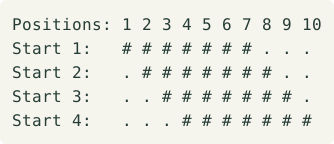
Compare all four placements. Positions 4, 5, 6, and 7 are filled in every version. You may fill those four squares immediately:
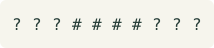
A question mark means undecided; it does not mean empty. This distinction matters: only fill the squares you can prove.
A shortcut for a single run
For a line of length L containing one run of length K, the minimum guaranteed central overlap (before accounting for any known X or filled cells) is:
max(0, 2K − L)
For the ten-cell row above, 2 × 7 − 10 = 4, so four squares are guaranteed.
| Line length | Single clue | Guaranteed overlap |
|---|---|---|
| 10 | 7 | 4 cells |
| 10 | 6 | 2 cells |
| 10 | 5 | 0 cells |
| 15 | 10 | 5 cells |
| 20 | 14 | 8 cells |
This formula applies to one run in an otherwise unrestricted line. For multiple clues, blockers, or partially solved rows, analyze all valid placements rather than applying it blindly.
Overlap with multiple clues: a 4 3 row
Now take a ten-cell row with clues 4 3. You need a four-square group, at least one empty square, and then a three-square group.
The leftmost and rightmost placements are:
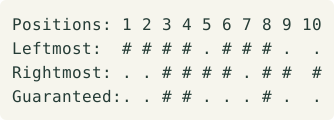
Because the groups cannot swap order or overlap each other, every legal placement includes positions 3, 4, and 8. Those are safe to fill; the other positions remain undecided.
When you use this technique on a multiple-clue line, remember that the mandatory gaps are part of the total space the clues require.
Use crosses and confirmed cells to strengthen overlap
Known empty cells shorten the space available for a run. For example, suppose the ten-cell row with clue 7 already has an X at position 10. Now the seven-square run must fit inside positions 1–9; its possible starts are 1, 2, or 3. That makes positions 3–7 guaranteed rather than only 4–7.
The more a line is constrained by X marks and crossing columns, the more useful overlap becomes.
A reliable process is:
- Pick a row or column with a long clue relative to its available space.
- Consider its earliest legal placement.
- Consider its latest legal placement, including required gaps between groups.
- Fill only the cells included in every legal placement.
- Re-check crossing lines; they may now produce additional confirmed fills or X marks.
For complicated partially filled lines, the earliest and latest sketches are a useful guide, but make sure both sketches represent legal placements that agree with all existing cells. If the line has several groups or blockers, checking each valid arrangement is safer than using a shortcut.
A common mistake: filling the entire run
With clue 7 in a ten-cell row, it is tempting to fill seven cells in the center. But the clue does not yet reveal the run's actual start. Only the four overlapping middle cells are guaranteed.
Avoid replacing uncertainty with guesses. Each correctly filled overlap cell becomes evidence for the crossing column and often unlocks the rest of the puzzle naturally.
When does overlap work best?
Overlap is especially effective when a line is nearly full. A row of length ten with clue 9, for instance, guarantees eight middle squares even before you inspect the columns. By contrast, a single clue of 3 in ten cells provides no guaranteed overlap on its own.
Look for long runs first, but do not ignore smaller clues once columns supply additional constraints. Use the edge logic technique to exploit confirmed cells and the outer boundaries of the puzzle.
Try it in a real puzzle
Open a 10×10 Nonogram, scan all the rows and columns, and write down which lines have the most restricted placement. Fill only their forced overlap cells. Then repeat the scan after the crossings update. Practicing this loop is much more valuable than memorizing a fixed pattern.
If the clues themselves are unfamiliar, first read How to Play Nonogram.
FAQ
Is overlap the same as guessing where a run goes?
No. Overlap identifies cells that are filled in every valid placement. You do not commit to one placement before you have enough evidence.
Does the 2K − L formula work for multiple numbers?
Not directly. The formula describes a single run in a line with no additional restrictions. Multiple runs need mandatory gaps and separate placement analysis.
What if there are no guaranteed overlap cells?
Switch to another row or column, use confirmed X marks to restrict placements, or apply edge and crossing clues. Not every line gives an immediate move.