
Nonogram Edge Logic: Solve Tricky Rows and Columns Step by Step
Use boundaries, completed groups, and crossing clues to force the next move.
Play NonogramWhen the easy rows are finished, Nonograms become a puzzle of constraints: a confirmed square near an edge can tell you where an entire group must go. Edge logic uses the boundary of a row or column, along with known filled and empty cells, to eliminate impossible placements.
It works well alongside the overlap technique. Overlap finds cells shared by every placement; edge logic uses what you already know about the start or end of a line to pin down groups.
Technique 1: A filled corner can lock a group
Consider a ten-cell row with clues 3 2. Suppose crossing-column deductions prove that the very first cell is filled.
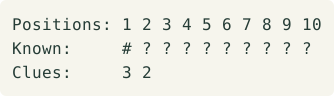
Because the first cell is filled, it must belong to the first group. There is no room for a filled group before it, so the three-square group must occupy positions 1–3. Position 4 must be empty to separate the groups:
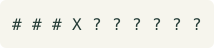
The second group has length two, but its exact location is still unknown. Do not fill it until the crossing column clues give more information.
Rule: If the first cell of a line is filled, the first run begins at that edge. The same applies in reverse when the last cell is filled.
Technique 2: An X at the boundary moves the start point
Now imagine an eight-cell row with a single clue 4, and the first two cells are confirmed empty:
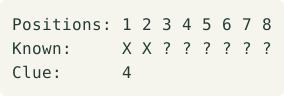
The four-square group must fit within positions 3–8. Its possible placements are:
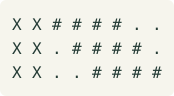
All three contain positions 5 and 6, so those two cells can be filled immediately:
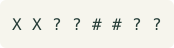
Notice how the two X marks turned an otherwise flexible clue into a useful deduction. A confirmed X is not just a note; it changes what can logically fit.
Technique 3: Complete a group, then close it off
Suppose a nine-cell row has clues 2 3. You already know that the second group has exactly three filled squares at positions 6–8:
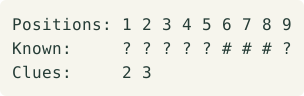
Because positions 6–8 form the final three-square run, position 9 must be empty. Position 5 must also be empty; otherwise the three-square run would extend beyond its clue length.
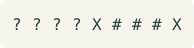
The earlier two-square group must now fit somewhere within positions 1–4. You still need column information to locate it precisely.
Important: Only close a group this way after you know those filled squares form a complete group. Three adjacent filled cells could be part of a longer run if the clue calls for four or more.
Technique 4: Alternate between rows and columns
Nonograms are not solved one row at a time. A useful loop is:
- Find a line with a confirmed square near its edge or a restrictive X mark.
- Determine which run that square can belong to.
- Extend only what is forced by the clue length and order.
- Mark an empty separator when a run is complete.
- Revisit the crossing lines that received new information.
- Repeat until another line becomes constrained.
A single X on a row can force a column's long run to shift. That forced column fill can then lock the start of another row. The progress may look slow at first, but these deductions compound.
What if a filled cell does not touch the outer edge?
A filled square near an edge is not always enough to fix a run. For example, with clue 4 in a ten-cell row, a filled cell at position 2 could belong to a run beginning at position 1 or 2. You cannot choose between those starts without another clue.
Instead, list the placements consistent with the known cell and look for their intersection. This is where edge reasoning and overlap reasoning work together.
Common edge-logic mistakes
Treating an unmarked square as empty. Only an X or a logically confirmed empty cell is a blocker. A blank unknown square might still be filled.
Forgetting required gaps. A 3 2 clue cannot form five consecutive filled squares. The groups must be separated by at least one empty square.
Extending a partial group too far. A pair of confirmed filled squares might be the middle of a four-square run, not the beginning. Check the clue and boundaries before extending it.
Assuming every puzzle has a forced next move. Some poorly specified puzzles admit multiple solutions. If no deduction works, check your earlier marks and whether the current puzzle offers a unique logical solution.
A simple practice routine
In a 10×10 puzzle, start with any full or near-full clue. Use overlap logic to fill guaranteed squares. Then scan for filled cells in the first or last positions of a line. Close completed groups with X marks, and repeat across the intersecting clues.
For a full explanation of clue notation and gaps, see How to Play Nonogram.
FAQ
Is edge logic only useful on the outer border of the puzzle?
No. Although grid boundaries are the easiest starting point, confirmed X marks can create an effective boundary inside a line. Reason about each remaining segment in the same way.
Can I use edge logic on columns?
Yes. A column is simply a vertical line. All the same run lengths, mandatory gaps, and edge constraints apply from top to bottom.
Should I fill guessed squares to see what happens?
Try to avoid guessing in a logic puzzle. Use confirmed cells, all possible legal placements, and crossing constraints first. An unproven fill can create a chain of misleading deductions.