
How to Play Nonogram: Rules, Clues, and Your First Puzzle
Learn the rules, read clues, and work through a complete 5×5 puzzle.
Play NonogramNonograms are picture logic puzzles. You fill certain squares on a grid by interpreting number clues beside each row and above each column. When you finish, the filled squares form a small pixel picture. The same style of puzzle is also called Picross, Griddlers, or picture crosswords.
The goal is not to color a picture by intuition. Every filled square should follow from the clues. Start with the short example below, then try the same reasoning in a larger puzzle.
The rules in one minute
- Each number represents a consecutive group of filled squares. For example, 4 means four adjacent filled squares.
- When a clue contains multiple numbers, the groups appear in the stated order and have at least one empty square between them. For example, 2 1 means two filled squares, then at least one empty square, then one filled square.
- There can be additional empty squares before the first group, after the last group, or between groups.
- Row clues describe horizontal runs; column clues describe vertical runs. Both must be satisfied at once.
- An empty-line clue, sometimes shown as 0, means that the entire row or column is empty.
- Marking a cell with X means you have concluded it is empty. An X is not a filled square.
A clue of 3 does not mean three filled squares scattered anywhere in the line. They must touch. A clue of 1 1 means two separate single squares: # . # is valid, but # # is not.
A complete 5×5 example
Below is a tiny heart-shaped puzzle. A dot (.) means an empty square and a hash (#) means a filled square. The solution is shown for teaching purposes; cover it while following the steps if you want to solve it yourself.
Row clues (top to bottom):
| Row | Clue |
|---|---|
| 1 | 1 1 |
| 2 | 5 |
| 3 | 5 |
| 4 | 3 |
| 5 | 1 |
Column clues (left to right):
| Column | Clue |
|---|---|
| 1 | 2 |
| 2 | 4 |
| 3 | 4 |
| 4 | 4 |
| 5 | 2 |
Step 1: Fill the obvious full rows
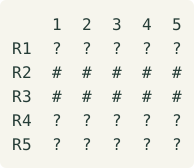
Rows 2 and 3 both have clue 5 in a five-cell-wide puzzle. There is only one place for five consecutive filled squares: fill every cell in those rows.
Step 2: Use the column clues
Columns 1 and 5 each require exactly 2 consecutive filled squares. Rows 2 and 3 already provide both, so cells in rows 1, 4, and 5 of those columns must be empty. Mark them X.
Columns 2, 3, and 4 each have clue 4. Because rows 2 and 3 are already filled, the four-square run must be either rows 1–4 or rows 2–5. The row clues help us choose.
Step 3: Finish the short rows
Row 4 has clue 3. Its first and last cells are already ruled out, so the three consecutive filled squares must be in columns 2–4.
Columns 2, 3, and 4 already contain three consecutive fills in rows 2–4. Each column needs exactly one more filled square, either in row 1 or row 5. Row 1 requires two separate single squares, while row 5 allows only one filled square. Therefore row 1 must fill columns 2 and 4, leaving column 3 for row 5.
Column 3's four-square run now occupies rows 2–5, so row 1, column 3 is empty. The two filled squares in row 1 are correctly separated by that empty cell.
Completed picture:
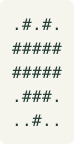
Every row and column matches its clues. This particular 5×5 clue set has exactly one solution.
How to use Fill, Mark, and Hint
In Uletime's Nonogram game, use Fill when a square must be part of the picture, and Mark when you can prove it is empty. The Mark mode is particularly useful as puzzles become larger: it prevents you from accidentally extending a group across a gap.
If you get stuck, look for a line whose clue nearly fills the available space before using Hint. For example, a clue of 7 in a ten-cell line guarantees several central squares. The overlap technique explains why.
The Check progress control can help you see whether your current work agrees with the puzzle, but it is not a substitute for understanding the clues.
Common beginner mistakes
Forgetting the gap: A clue of 2 2 needs at least five cells, not four: ##.##.
Treating X as filled: An X means confirmed empty. It helps separate runs; it does not count toward a numbered clue.
Solving rows in isolation: A row may have several possible patterns. Use crossing column clues to eliminate possibilities rather than guessing.
Assuming a clue fixes its position: In ten cells, a clue of 3 can appear in many locations. It says how long the run is, not where it starts.
Ignoring completed lines: As soon as all the groups in a line are accounted for, mark any remaining cells empty. Those empty cells often unlock crossing lines.
What should you solve next?
Once a 5×5 puzzle feels comfortable, move to 10×10 and practice identifying guaranteed squares. For more challenging rows and columns, learn overlap logic and edge logic. These techniques let you make progress without trial and error.
FAQ
Is Nonogram the same as Picross?
They use the same core row-and-column run-length logic. Picross is a widely used name for this style of picture puzzle; individual games may differ in controls, hints, colors, or scoring.
Do numbers tell me exactly where to fill?
No. A clue tells you the sizes and order of groups, not their exact positions. You must combine row and column information.
Do I have to place X marks?
Not always. However, marking squares that are definitely empty makes complex puzzles easier to follow and reduces mistakes.
Can every Nonogram be solved without guessing?
Not every possible set of Nonogram clues guarantees a unique solution or a deduction-only path. Well-designed puzzles should give players a fair logical route; if you feel forced to guess, check whether you missed a completed line or a useful crossing clue.